Chin Ups and Pull Ups
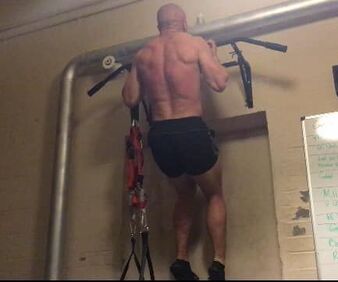
Chin ups and pull ups
Both chin and pull ups are one of the best back exercises.
They strengthen the back (lats, middle and lower traps, rhomboids), biceps and your grip strength.
They strengthen the back (lats, middle and lower traps, rhomboids), biceps and your grip strength.
The differences between pull ups and chin ups
Pull Ups - An overhand grip where your palms point outwards so that they are facing away from you.
Chin Ups - An underhand grip where your palms point inwards so that they are facing you.
Neutral Grip - Where your palms are facing each other.
Most people will usually be stronger at chin ups than they are at pull ups. Chin ups works your biceps a bit harder.
Chin Ups - An underhand grip where your palms point inwards so that they are facing you.
Neutral Grip - Where your palms are facing each other.
Most people will usually be stronger at chin ups than they are at pull ups. Chin ups works your biceps a bit harder.
How to do a pull ups, chin up and neutral grip pull ups
- Grab the bar with your hands around shoulder-width apart. The grip will depend on whether you’re doing chin ups, pull ups, or neutral grip pull ups.
- Retract your shoulder blades to reduce the stress on the shoulder joints. Don't let them round forward
- Keep your body stable and core engaged, squeeze your glutes and don’t let your legs flop around
- Pull your body up until your chin is over the bar
- Slowly lower to the start position.
- To progress, you can add sets or reps, add weight and work towards a one arm chin up. The one arm chin up is very advanced and not many people will achieve this.
What to do if you can't do a single pull up
Here are some ways to work towards doing them.
- Lose weight. Carrying too much fat will make pull ups much harder. Just losing weight is often all someone needs to do to be able to do a single rep.
- Eccentric work . This is just doing the going down part of the pull up. Jump up into the top of the pull up, then lower yourself at a slow tempo. Most people will be able to lower themselves down even if they can’t do a pull up. Over time you'll try and increase the time it takes to lower yourself and then add holds.
- Eccentric with holds. Like the eccentric work above, you climb to the top and just do lowering part of the pull up, but this time hold the position at certain points. For example, hold the position near the top, middle and towards the bottom. Over time you can increase the time you do the holds.
- Get better at lat pull downs and other back exercises.
- Resistance bands. You can hang resistance band from the bar and wrap it around your knees. I don't think this is the best option and while it's the method most people use, it doesn't work as well.
How to progress
Over time you Increase the number of reps you can do with your bodyweight. One way I liked to do this was to use the ladder method. For example, if you can do 8 reps for a single set, you could set it up like this. Start with 1 rep and increase until you get to six reps, and then go back down again. So it would look like this 1-2-3-4-5-6-5-4-3-2-1. This gives you 36 reps. You could go back up and down the ladder again so you'll do 72 reps.
A lot of people only stick with using bodyweight and never try to progress, but it should be treated just like any other exercise and have the resistance increased. Once you're able to do a decent amount of reps with your bodyweight you can,
A lot of people only stick with using bodyweight and never try to progress, but it should be treated just like any other exercise and have the resistance increased. Once you're able to do a decent amount of reps with your bodyweight you can,
- Add weight by using a dipping belt.
- You can also start training to do a one pull up, or one arm chin up by using the progressions below
Weighted chin ups and pull ups
Hang a dipping belt from your waist and do chin ups with added weight. This is the easiest way to make the exercise harder once using bodyweight is too easy. You can treat it like any barbell and dumbbell exercise and progress the same way. The double progression method works well.
Hang a dipping belt from your waist and do chin ups with added weight. This is the easiest way to make the exercise harder once using bodyweight is too easy. You can treat it like any barbell and dumbbell exercise and progress the same way. The double progression method works well.
|
Start training to do a one arm pull up
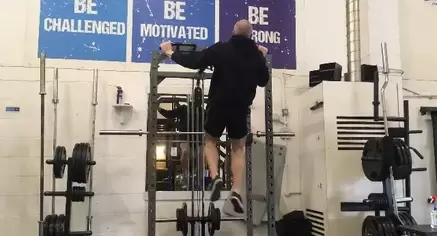
Side to side pull ups: Side to side pull ups is a good way to start training for a one arm chin up. With the exercise, you pull up to the side instead of straight up. Make sure you do the same amount of reps on each side. You're still using both hands, but the arm you pull towards will do most of the work. |
|
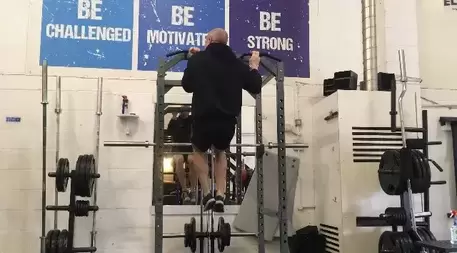
Assisted one arm chin ups
With this variation, you pull with one arm and use the other arm only as much as you need to complete the reps. In the picture, you'll see I'm only holding on with my fingertips on my right hand. Over time you'll use the supporting arm less and less until you can do a full rep with just one arm. Make sure you work both sides equally.
One arm Eccentrics
Do a full pull up with both arms and then lower yourself as slowly as you can while only holding on with one hand. Repeat this but lower yourself with the other hand. Make sure you alternate hands and work both sides evenly. Be careful when you first start doing these as you will end up with elbow pain if you over do it and do too much too soon. Start slow and build it up.
Do a full pull up with both arms and then lower yourself as slowly as you can while only holding on with one hand. Repeat this but lower yourself with the other hand. Make sure you alternate hands and work both sides evenly. Be careful when you first start doing these as you will end up with elbow pain if you over do it and do too much too soon. Start slow and build it up.
Chris Adams